

Aluminum profile extrusion principle, classification and application
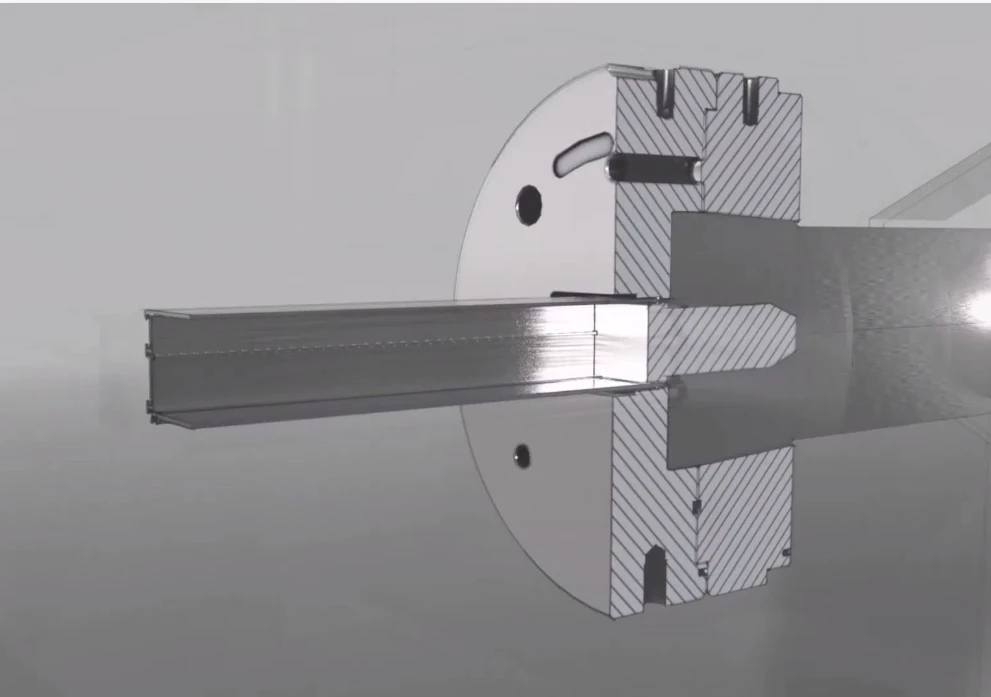
1. The principle of aluminum extrusion
Aluminum profile extrusion is a plastic processing method that applies external force to the metal billet placed in the container (extrusion cylinder) to make it flow out of a specific die hole to obtain the required cross-sectional shape and size.
2. Composition of aluminum profile extrusion machine
The aluminum profile extrusion machine is composed of machine base, front column frame, expansion force column, extrusion cylinder, hydraulic system under electrical control, and is equipped with mold base, thimble, scale plate, slide plate, etc.
3. Classification of aluminum profile extrusion methods
According to the type of metal in the aluminum profile extrusion cylinder, the state of stress and strain, the extrusion direction of the aluminum profile, the lubrication state, the extrusion temperature, the extrusion speed, the type or structure of the die, the shape or number of the blank, and the shape of the product Or different numbers, etc., can be divided into forward extrusion method, reverse extrusion method, (including plane deformation extrusion, axisymmetric deformation extrusion, general three-dimensional deformation extrusion) lateral extrusion method, glass lubricated extrusion method, hydrostatic extrusion method, continuous extrusion method and so on.
4. Forward thermal deformation extrusion
The vast majority of heat-deformed aluminum production enterprises use forward heat-deformed extrusion methods to obtain aluminum materials with the required cross-sectional shape through specific molds (flat die, cone die, split die). The only aluminum production method adopted!
The forward extrusion process is simple, the requirements for equipment are not high, the metal deformation capacity is high, the production range is wide, the performance of aluminum materials is highly controllable, the production flexibility is large, and the tools and molds are easy to maintain and correct.
The disadvantage is that the friction between the inner surface of the extrusion cylinder and the aluminum material is strong, which accounts for a large proportion of the extrusion energy consumption. The friction easily causes the ingot in the cylinder to heat up and increases the instability of the profile, which impairs the improvement of the efficiency of the finished product and limits the aluminum and aluminum alloys. The extrusion speed of the alloy accelerates the wear and service life of the extrusion die, and the microstructure and performance of the product are uneven.
5. Types, properties and uses of heat-deformed aluminum alloys
The types of heat-deformed aluminum alloys are divided into 8 categories according to their performance and usage requirements, and their performance and usage are different.
1). Pure aluminum (L series) corresponds to the international grade 1000 series pure aluminum,
Industrial pure aluminum, excellent in machinability, corrosion resistance, surface treatment and electrical conductivity, but low strength, used in household products, electrical products, medicine and food packaging, power transmission and distribution materials, etc.
2). Hard aluminum (Ly) corresponds to the international brand 2000 AL-Cu (aluminum-copper) alloy.
Applied to large components, brackets, high Cu content, poor corrosion resistance.
3). Anti-rust aluminum (LF) corresponds to the international brand 3000 AL-Mn (aluminum-manganese) alloy.
It cannot be strengthened by heat treatment, its machinability and corrosion resistance are comparable to those of pure aluminum, its strength has been improved, and its welding performance is good. It is widely used in daily necessities, building materials, devices, etc.
4). Special aluminum (LT) corresponds to the international brand 4000 AL-Si (aluminum-silicon) alloy.
Mainly welding materials, low melting point (575-630 degrees), good fluidity and fluidity.
5). Anti-rust aluminum (LF) corresponds to the international brand 5000AL-Mg (aluminum-magnesium) alloy.
It cannot be strengthened by heat treatment, and has excellent corrosion resistance, weldability, and surface gloss. By controlling the content of Mg, alloys of different strength levels can be obtained. Few are used for decorative materials and advanced devices. Used in ships, vehicles, building materials. High welded components for ships, vehicles and chemical plants.
6). 6000AL-Mg-Si alloy
Mg2Si precipitation hardening heat treatment can strengthen the alloy, with good corrosion resistance, medium strength and excellent hot workability, so it is widely used as extrusion material, with good formability and high hardness can be obtained through quenching. It is widely used in building profiles, and it is also the most important source of materials in industry.
7). Super duralumin (LC) corresponds to the international brand 7000AL-Zn-Mg-Cu (aluminum-zinc-magnesium-copper) high-strength aluminum alloy and AL-Zn-Mg alloy for welding components.
High strength, excellent welding and quenching performance, but the disadvantage is that the resistance to stress corrosion cracking is poor, which needs to be improved by taking appropriate heat treatment. The former is mainly used in aircraft and sporting goods, and the latter is mainly used in welding structural materials for railway vehicles.
8): 8000 (AL-LI) aluminum-lithium alloy
The biggest feature is that the density is 8%~9% lower than that of the 7000 series, high rigidity, high strength, and light weight. This series is under development (the anti-decay ability of aluminum alloy metal under complex conditions has not yet been completely overcome), and it is mainly used in aircraft and missiles. , engines and other military uses.