

If you want to buy the right doors and windows, you must know these hardware accessories!
As we all know, the hardware of doors and windows determines the performance of doors and windows. Below, the editor will take you to learn about the hardware accessories of doors and windows in detail to help you better choose door and window products.

1. Hinges
Ordinary hinges: used for cabinet doors, windows, doors, etc. The materials are iron, copper, and stainless steel. The disadvantage of ordinary hinges is that they do not have the function of spring hinges. After installing the hinges, various bump beads must be installed, otherwise the wind will blow the door panels.
Pipe hinges: also called spring hinges. Mainly used for the connection of furniture door panels, it generally requires a plate thickness of 16~20 mm. The materials are galvanized iron and zinc alloy. The spring hinge is equipped with an adjustment screw, which can adjust the height and thickness of the plate up and down, left and right. One of its features is that it can be matched with the cabinet door opening angle according to the space. In addition to the general 90-degree angle, 127 degrees, 144 degrees, 165 degrees, etc. have corresponding hinges to match, so that various cabinet doors have corresponding extensions.
Door hinge: It is divided into ordinary type and bearing type. The ordinary type has been mentioned before. The bearing type can be divided into copper and stainless steel in terms of material. From the current consumption situation, copper-bearing hinges are more often used because they are beautiful, bright, moderately priced, and equipped with screws.
Other hinges: There are glass hinges, countertop hinges, and flap hinges. Glass hinges are used to install frameless glass cabinet doors, and the glass thickness is required to be no more than 5~6 mm.
2. Hinges
Hinges are divided into clear hinges and concealed hinges. Clear hinges are the ones we usually see on most doors, which have no rebound force. Concealed hinges are mostly used on furniture and can be divided into hydraulic, quick-install, frame doors, and ordinary ones.
3. Tracks
Door and window slide rails are guide rails for sliding doors and windows, usually with grooves or curves. Ball bearings are often installed to facilitate the sliding of doors and windows. Refers to sliding door tracks, hanging wheels, glass pulleys, and latches (clear and concealed).
4. Door suction
The door section is installed behind the door. After the door is opened, it is stabilized by the magnetism of the door suction to prevent the door from being blown and automatically closed.

5. Floor suction
The floor suction is a type of door suction, also known as floor-mounted door suction. Door suction, also known as door touch, is also a device that sucks and positions the door leaf after it is opened to prevent the door leaf from being closed by the wind or touching it. However, in daily life, door suction often refers to wall-mounted door suction, that is, door suction installed on the wall; floor suction refers to floor-mounted door suction, that is, door suction installed on the ground.
6. Door clamp
The door clamp refers to the glass door clamp, which is a hardware accessory used to clamp the glass door with the floor spring or ground axis to make the door operate normally. It is widely used in glass doors and windows, bathroom doors, and shower rooms.
7. Door closer
The door closer is a spring-like hydraulic device that can automatically close or fix the open door leaf in a certain position. When the door is opened, it can be released after compression to automatically close the door. It has the function of a spring door, which can ensure that the door is accurately and timely closed to the initial position after it is opened. Some of them also have the function of hinges, and some have fireproof properties. The main varieties include floor springs, door top springs, door slingshots, door stoppers, door clamps, magnetic door suction heads, etc.
Door closers are a kind of spring-like hydraulic device that can automatically close or fix the open door leaf in a certain position. When the door is opened, it can be compressed and released to automatically close the door. It has the function of a spring door and can ensure that the door is accurately and timely closed to the initial position after it is opened. Some of them also have the function of hinges, and some have fireproof properties. The main varieties include floor springs, door top springs, door slingshots, door stoppers, door clamps, magnetic door suction heads, etc.
(1) Floor spring: also known as floor dragon. Installed at the bottom of doors and windows. Made of gray cast iron, carbon steel, spring steel, cast steel, etc., it is assembled after processing.
(2) Door top spring: an automatic door-closing device that uses the elastic force of a spring-type spring or a spiral spring to close the door leaf. A buffer cylinder is installed inside to reduce the closing speed.
(3) Door slingshot: It is made of a low-carbon steel strip and equipped with a low-carbon cold-drawn steel top rod. It uses elastic force to close the door.
(4) Door stopper: A simple positioner that brakes the door leaf and prevents the door leaf from colliding with the wall. It is installed at the outer lower corner of the door leaf and can position the door leaf at any angle.
(5) Door clamp: A device for fixing and opening the door leaf. It consists of a knife-shaped base and a triangular steel clamp. There are two types: horizontal and vertical. The base is cast in gray cast iron; the clamp is made of spring steel and the surface is blued.
(6) Magnetic door suction head: It has the same function as the door clamp door and window hardware head. It uses the suction force of a permanent magnet to fix the door leaf. It is noiseless when used.
8. Window opener
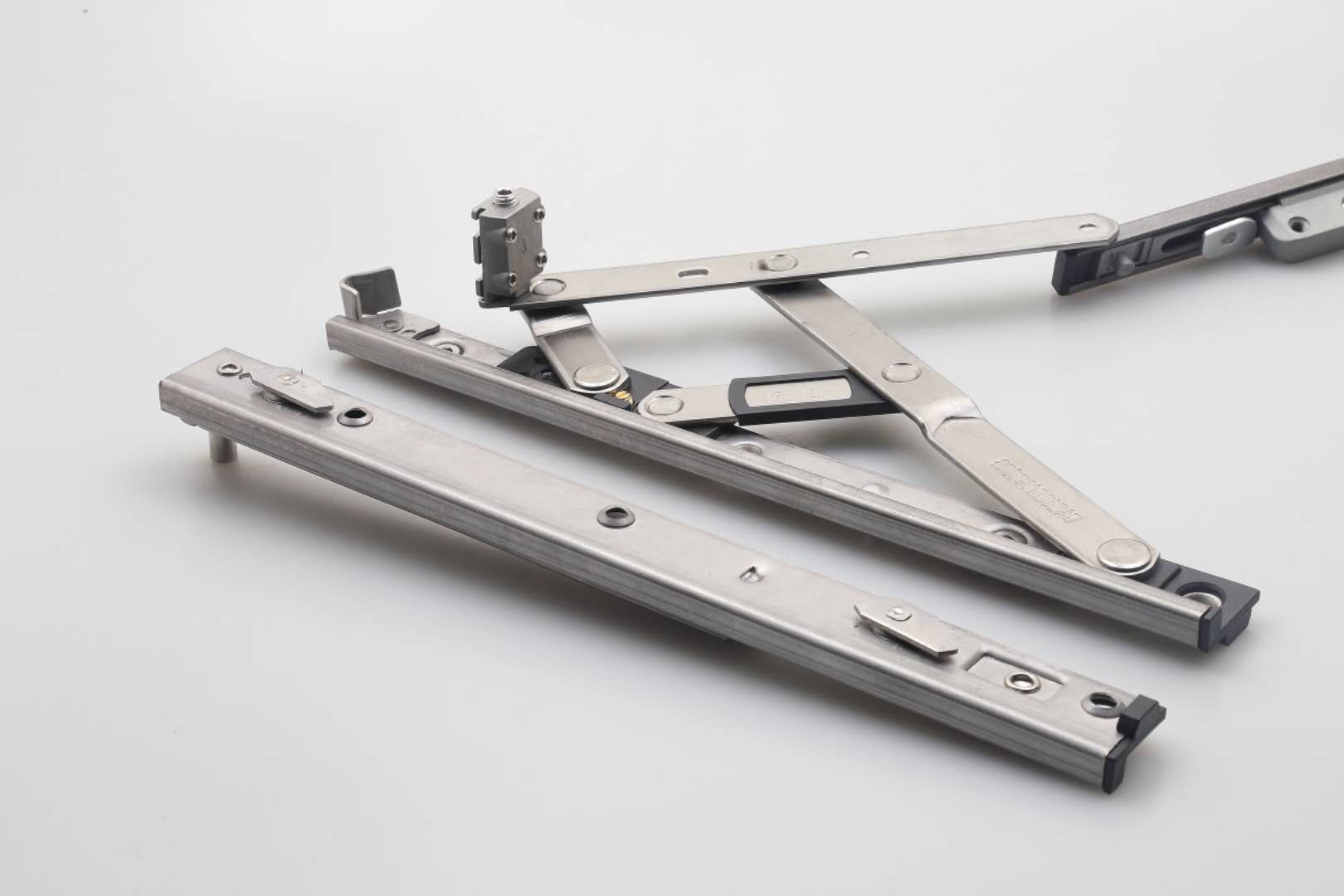
The window opener can open the ventilation window at a higher position through a certain device. The window opening actuator determines the window opening width, the load-bearing weight of the window opener, and whether it has a locking function. The corner connector is a transmission component, and its deformation determines the ability of the window opener to adapt to different window types and different installation conditions. The operating component can be in the form of a handle or a rocker. There is also a manual window opener, which is suitable for hanging inside and hanging outside windows.
9. Door mirror
The door mirror is commonly known as a cat's eye. Its function is to look out from the room through the door mirror, and you can see all the scenes outside the door within a field of view of about 120 degrees, but you can't see anything inside the room through the door mirror from outside the door. If this mirror is installed on the door of a public house or private apartment, it can play a certain role in the anti-theft and safety of the family. 10. Bead (copper, aluminum, PVC).
The material of the bead matches the main material of the window, such as plastic steel, aluminum alloy, and steel. The bead is mainly used to control the gap size of the glass groove, block the glass, and prevent the glass from falling off.
10. Induction door opening device
An electronic device used for automatic light-opening door leaves. The main device is a microwave induction or light-controlled induction contact. It can automatically input the induction signal of the human body or object to automatically open or close the door leaf. It is generally used in conjunction with automatic doors and transmission machinery.
11. Handle
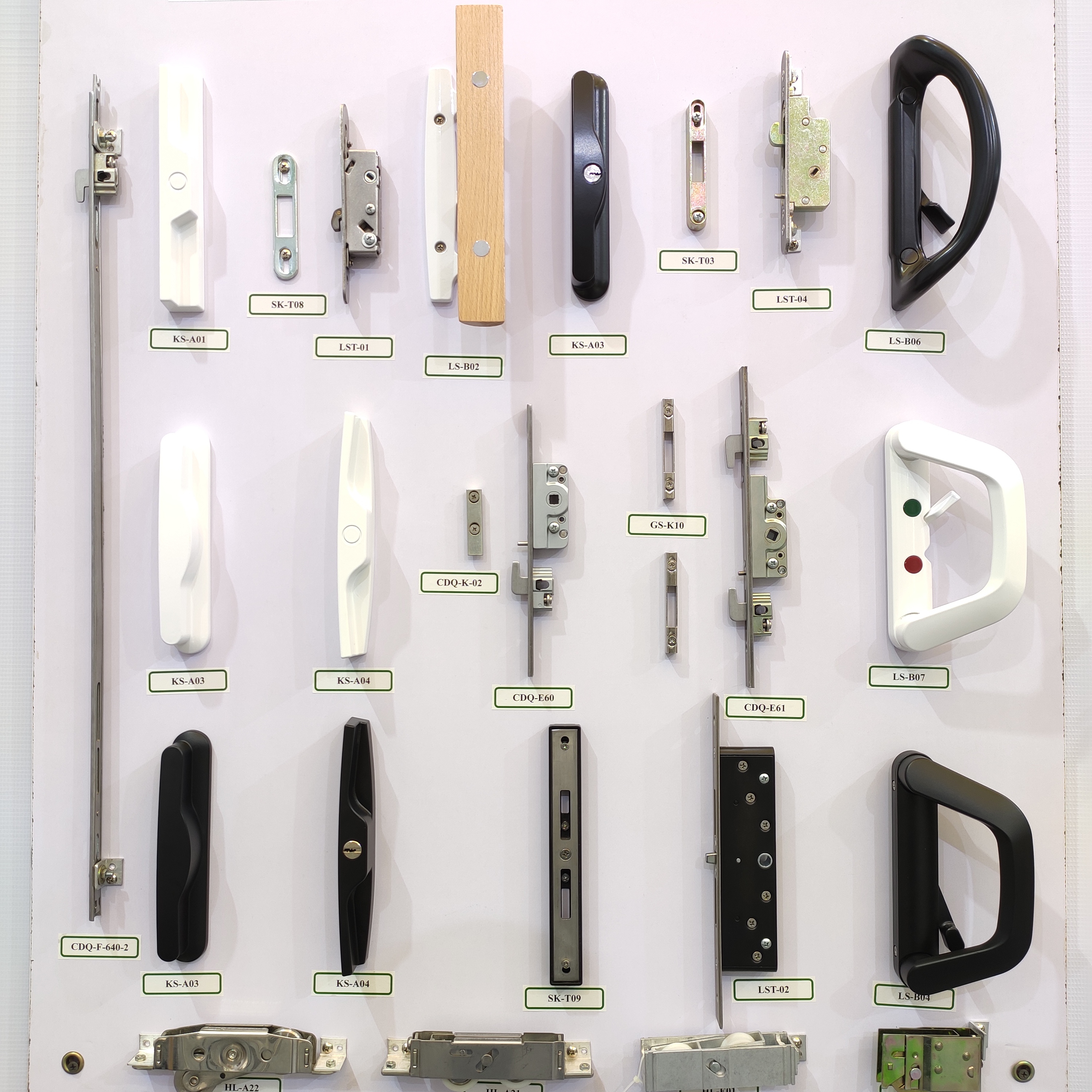
The handle is installed on the door leaf of the building to pull the door leaf open. It is generally installed on the outside of the door leaf of the building, and it is required to be practical, sturdy, and decorative. The handles have various shapes such as round handles, square handles, round tube handles, double-row handles, etc. They are generally made of copper, aluminum, stainless steel, ceramics, low-carbon steel, stainless steel, aluminum alloy, and plexiglass. The handles that have been electroplated and electrostatically sprayed are wear-resistant and corrosion-resistant. When choosing, in addition to matching the decoration style of the room, they should also be able to withstand greater tension and play a protective role, so that the home is in a safe state.

12. Latch
The so-called latch is a set of pins used to fix the workpiece on the fixture or mold to lock the door and window when it is closed. A simple component to prevent opening is an anti-theft component that prevents doors and windows from being opened from the outside. The structure is much simpler than the lock, but the lock is outside the door and the latch is inside the door. There are many forms such as ordinary type, closed type, tube type, butterfly type latch and concealed latch, upper and lower long latch, and window latch. It is mostly made of low-carbon steel.
13. Building door lock
A lock is installed on the door leaf and door frame of a building that needs to be opened and closed. Generally, it consists of a lock body (including lock bolt door and window hardware, operating mechanism, and braking mechanism) as well as a lock panel, handle, cover plate, etc. The lock bolt can be divided into oblique bolt, square bolt, double bolt, bead bolt, and hook bolt; the lock panel can be divided into flat, left tongue, right tongue, and round bolt; the handle can be spherical, curved, and pull ring.
Building door locks can be divided into door locks, room door locks, bathroom door locks, windproof passage door locks, and toilet door locks according to the occasion of use; they can be divided into single insurance, double insurance, and triple insurance door locks according to the insurance performance; they can be divided into external door locks, mortise door locks, and spherical door locks according to the structural characteristics.
(1) External door lock: The lock body covers the surface of the door leaf. The main products include single-tongue single insurance door lock, single-tongue double insurance door lock, single-tongue triple insurance door lock, double-tongue triple insurance door lock, double-tongue double lock head triple insurance door lock, multi-tongue double lock head triple insurance door lock, etc.
(2) Mortise lock: The lock body is embedded in the door leaf from the side. There are two types: blade structure and pin structure. The main products include sliding door mortise locks, single tongue mortise locks, single oblique tongue mortise locks, single oblique tongue button mortise locks, double tongue mortise locks, double tongue pressure mortise locks, blade handle locks, etc.
(3) Spherical door lock: Beautiful appearance, easy to use, mostly used in high-end buildings.
14. Handle
Used to open and close metal window sashes. Generally installed in the middle of the edge of the window sash, some are also designed to be connected to the door and window hardware with the bolt. Mostly made of brass, low-carbon steel, zinc alloy, stainless steel, and other materials, and the surface is plated with nickel, chrome, or zinc.
15. Sliding support
Used to position the opened metal window sash. Generally installed at the lower edge of the window sash, some are also designed to be used with the hinge. Mostly made of brass, low-carbon steel, zinc alloy, stainless steel, and other materials, and the surface is plated with nickel, chrome, or zinc. There are eye supports, double-arm supports, rocking supports, mobile supports, etc.
16. Window hook
Installed on wooden windows to fix the open window sash. Generally made of low-carbon steel wire and galvanized on the surface.
17. Anti-theft chain
Also known as a safety chain. It consists of two chain plates and a connecting chain. The chain plates are installed on the door leaf and the door frame respectively. The anti-theft chain can limit the door leaf to a smaller opening angle (generally not more than 8°), effectively preventing outsiders from breaking in.